





Enter your VAT number here and click Verify:
Your details have been verified. VAT number registered to:
,
.
Your order will now be zero rated for VAT purposes. We reserve the right to verify these details after your order request has been made and reinstate VAT if required.
Your VAT details were not recognised or were invalid. Your VAT number must be matched to your Billing Country as specified above. This is currently specified as . You do not need to enter the country code part of your VAT number as this has already been selected in your billing address details above.
The VAT number checking service is currently offline. Please supply your VAT details within the comments or special instructions field below and we will apply a VAT discount after placing your order request.
PMO

PMO for Porsche
PMO induction components are a popular choice for classic Porsche models, especially where owners are upgrading carburettors or rebuilding air-cooled engines for improved response and drivability
A Quick Look at PMO
PMO information on this page is based on details supplied by the manufacturer or distributor, plus any OE references provided with the parts.
Choosing the Right Fit for Your Porsche
Where PMO is listed for Porsche, use the supplied model coverage and OE references to confirm suitability. Check details that commonly affect fitment such as model year, side/position, and connector type where relevant.
- Typical reasons for choosing these parts include upgrading tired or worn original carburettor/induction setups, improving drivability, and supporting engine builds with better throttle response and tunability.
- Common symptoms that lead owners to carburettor work include hard starting, flat spots, poor idle quality, fuel smells, and inconsistent running, often linked to jetting, air leaks, or ignition issues.
- Before chasing carburettor problems, many specialists recommend confirming ignition timing, valve clearances, and checking for vacuum leaks, as these often cause “carb-like” symptoms.
- Carburettors and tuning components benefit from periodic checks, especially after engine changes, significant temperature/altitude shifts, or storage, to ensure jetting and synchronisation remain appropriate.
- For engine rebuild decisions, compression and leak-down tests, bore inspection, and oil/filter analysis are key checks before committing to a full strip-down.
- After any major tuning or carburettor change, final setup on a healthy engine (no vacuum or ignition faults) is important for stable idle and drivability.
Browse by Category
If you already know the area you are working on, start with the category and then filter by Porsche model. Where real-world symptoms and typical reasons to replace are provided, use them to keep the wording grounded.
Engine Rebuild Parts — Engine rebuild parts are typically renewed during a planned rebuild or when symptoms point to internal wear, such as loss of compression, excessive oil consumption, persistent leaks, abnormal noises, or contamination found in the oil. On Porsche engines, many specialists replace chains, guides, bearings, seals, fasteners, and gaskets while the engine is apart to avoid repeat strip-downs and to restore long-term reliability.
- Confirm engine health first with compression/leak-down tests, bore inspection, and oil/filter checks before deciding on the rebuild scope.
- Plan to replace hard-to-access wear items “while you are in there” to make the most of the labour already invested.
Carburetors & Parts — Carburettor parts are usually replaced when a Porsche engine shows poor starting, flat spots, fuel leaks, inconsistent idle, or when carbs are being refurbished after long storage. Seals harden, jets clog, floats can stick, and throttle shafts wear over time. Refurbishing or rebuilding classic Porsche carburettors helps restore correct fuelling, prevent leaks, and bring back clean throttle response and drivability.
- Many carburettors can be successfully rebuilt if the bodies are sound; replacement tends to depend on overall condition and performance goals.
- After fitting or rebuilding carbs, synchronisation, mixture setting, and correct fuel pressure/regulation are essential for smooth running.
PMO Carburetors — PMO carburettors are a common upgrade for classic Porsche performance builds where owners want a modern carb solution with strong parts support and tuning flexibility. They are often chosen when original carburettors are worn beyond economical repair, when an engine build needs greater fuelling capacity, or when a particular driving feel and throttle response is desired. Correct setup, including jetting, synchronisation, and linkage adjustment, is critical to getting the best from PMO systems.
- New PMO carburettors typically need jetting and synchronisation tailored to the specific engine specification rather than being treated as simple bolt-on parts.
- Most issues reported with carburettors, including PMO units, can be traced to incorrect jetting, air leaks, or poorly set-up linkages rather than the hardware itself.
Engine Tuning — Engine tuning components are used to improve drivability, fuel economy, throttle response, or to support hardware changes such as induction, exhaust, camshafts, or forced induction upgrades. On Porsche engines, tuning is also used to smooth out flat spots and poor cold or hot behaviour, but it cannot compensate for underlying mechanical problems, so engine condition checks are important before calibration changes.
- Before any tuning work, check compression and leak-down, fuelling system health, sensor data, and confirm there are no boost or vacuum leaks.
- A conservative, well-matched calibration combined with appropriate supporting hardware generally offers better long-term reliability than aggressive settings on a marginal engine.
Air Filters — Air filters are replaced or upgraded to maintain correct airflow and protect the engine from dirt ingestion. On Porsche models, a clogged or degraded filter can slightly reduce performance and fuel economy, while a poorly sealing element can allow dust into the intake, accelerating wear. Performance filters are often chosen to support tuning work and to maintain stable sensor readings in higher-flow setups.
- Service intervals depend on use and environment; cars driven in dusty conditions or on track may need more frequent inspection and cleaning/replacement.
- Where oiled filters are used, follow the manufacturer’s oiling instructions carefully to avoid contaminating air-mass sensors.
Explore PMO at Design911
View the current PMO range for Porsche at Design911, then filter by model and category to narrow down to the right parts.
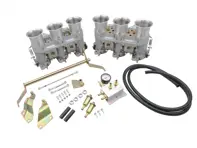

Please see the PMO vs OE Carb Overview

Fits
Porsche 911 - Air cooled engine with capacity 2.7ltr through to 3.0ltr
Carburettors, linkage and fuel regulator
PMO Induction utilises aerospace quality castings, machining tolerances, IDF jetting and float technology that is based on Weber's most modern carburettor design.
The original 46mm Weber carburettors simply have the throttle plate enlarged, whereas PMO’s have the
entire throttle body enlarged from the top throat through the plate meaning the air flow capabilities of
PMO Induction’s carburettors are significantly improved over the equivalent size Weber.
PMO Induction use a one-piece, machined stainless steel throttle shaft, supported by large ball
bearings for a lifetime of smooth throttle action negating the Weber carburettors biggest problem as
Weber carbs suffered greatly with throttle shaft wear, air leaks, and binding over the years. Weber throttles also suffer from heat soak
that exacerbate the wear issues but this does not affect PMO Induction carburettors.
The PMO Induction carburettors have a sight glass float bowl to allow for accurate setting of fuel levels,
much more simple and efficient than the Weber IDA method that requires partial a carburettor disassembly.
The fuel inlet system is also greatly improved to provide significantly improved flow capacity and fuel delivery balance against
the banjo set-up on the Weber carbs, which are highly prone to leak and are capacity limited on high flow applications.
Specification:
Carburettor Size - 40mm
Choke - 36
Mains - 145
Air Corrector - 190
Em Tubes - F11t
Idle Jets - 55
Float Check Valve - 0.5
* The engine cc range in the listings is an approximation based on typical displacement requirements utilising standard (stock) ported cylinder heads and factory style cams.
Any carb sets / manifolds should always be matched to the head port size for the standard (stock) engines.
**Engines with enlarged ports, higher compression ratios, race camshafts, will require additional components for tuning beyond the standard kit
specifications
- Porsche 911 1965-1968 2.0L / 912 SWB (F)
- Porsche 911 1968-1973 2.2L / 2.4L / 2.7L RS LWB (F)
- Porsche 911 1974-1977 2.7L / 1976-77 3.0 Carrera
- Porsche 911 1978-1983 3.0L / SC
 Shop Securely
 12 Month Warranty
 Worldwide Delivery
 Free delivery
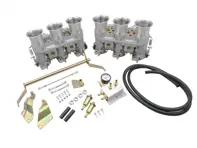
Replacing worn or faulty Weber carburettors or looking for increased performance? Choose PMO Induction carburetors
Weber carburettors are a good product, but they were designed for mass production. PMO Induction carburetors are highly engineered and designed to exacting standards tht are not feasible in typical mass production.
This is why we feel that PMO Induction carburetors are a superior product.
Please see the PMO vs OE Carb Overview
Fits
Carburettor x 2, linkage and fuel regulator.
PMO Induction utilises aerospace quality castings, machining tolerances, IDF jetting and float technology that is based on Weber's most modern carburettor design.
The original 46mm Weber carburettors simply have the throttle plate enlarged, whereas PMO’s have the
entire throttle body enlarged from the top throat through the plate meaning the air flow capabilities of
PMO Induction’s carburettors are significantly improved over the equivalent size Weber.
PMO Induction use a one-piece, machined stainless steel throttle shaft, supported by large ball
bearings for a lifetime of smooth throttle action negating the Weber carburettors biggest problem as
Weber carbs suffered greatly with throttle shaft wear, air leaks, and binding over the years. Weber throttles also suffer from heat soak
that exacerbate the wear issues but this does not affect PMO Induction carburetors.
The PMO Induction carburettors have a sight glass float bowl to allow for accurate setting of fuel levels,
much more simple and efficient than the Weber IDA method that requires partial a carburettor disassembly.
The fuel inlet system is also greatly improved to provide significantly improved flow capacity and fuel delivery balance against
the banjo set-up on the Weber carbs, which are highly prone to leak and are capacity limited on high flow applications.
Specification:
Carburettor Size - 40mm
Choke - 34
Mains - 135
Air Corrector - 185
Em Tubes - F11t
Idle Jets - 55
* The engine cc range in the listings is an approximation based on typical displacement requirements utilising standard (stock) ported cylinder heads and factory style cams.
Any carb sets / manifolds should always be matched to the head port size for the standard (stock) engines.
**Engines with enlarged ports, higher compression ratios, race camshafts, will require additional components for tuning beyond the standard kit
specifications
Related reference numbers
Related, superseded, cross reference or alternative numbers for comparison.
PM-O802-0
The product you are viewing cross references to these numbers
- Porsche 911 1965-1968 2.0L / 912 SWB (F)
- Porsche 911 1968-1973 2.2L / 2.4L / 2.7L RS LWB (F)
- Porsche 911 1974-1977 2.7L / 1976-77 3.0 Carrera
- Porsche 911 1978-1983 3.0L / SC
Shop Securely
12 Month Warranty
Worldwide Delivery
Free delivery
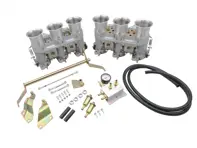
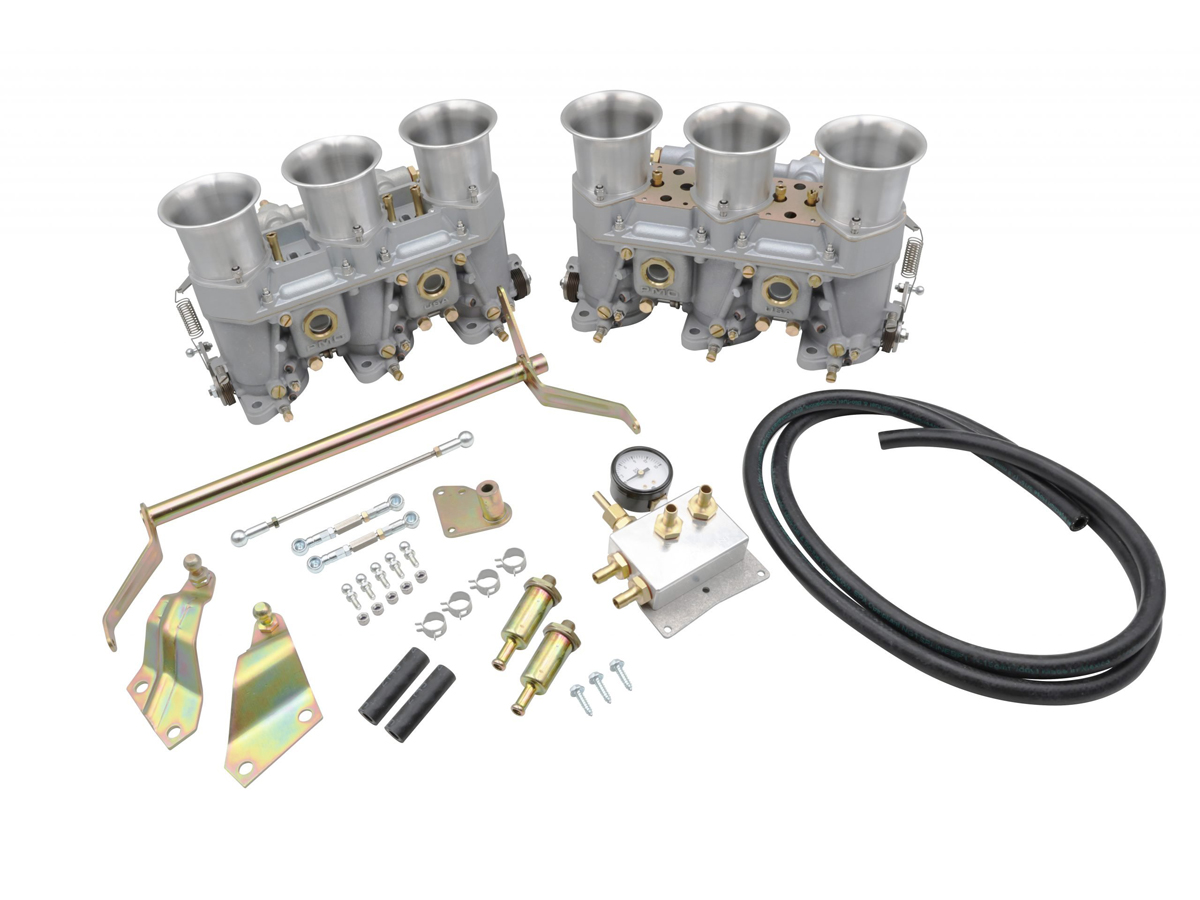
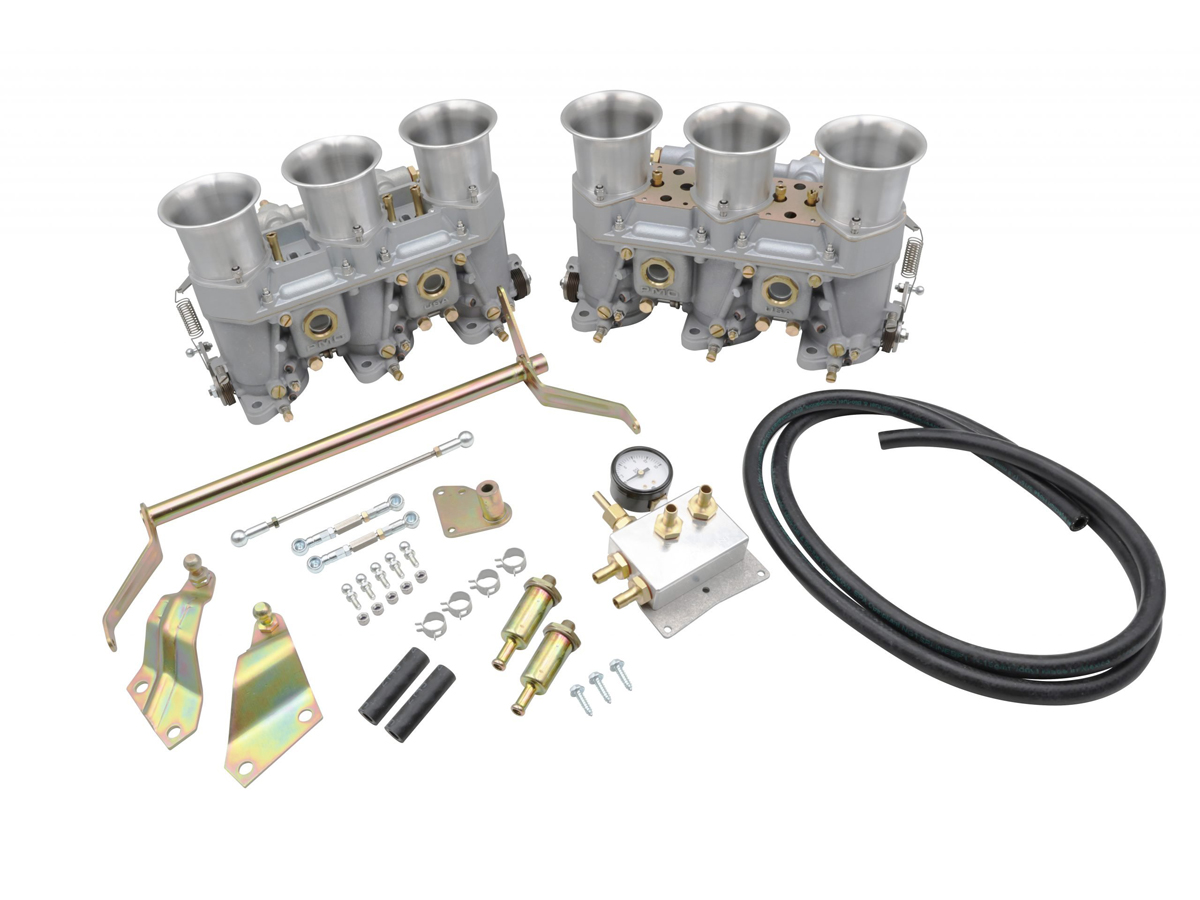

Please see the PMO vs OE Carb Overview
The original 46mm Weber carburetors simply have the throttle plate enlarged, whereas PMO’s have the
entire throttle body enlarged from the top throat through the plate meaning the air flow capabilities of
PMO Induction’s carburetors are significantly improved over the equivalent size Weber.
PMO Induction use a one-piece, machined stainless steel throttle shaft, supported by large ball
bearings for a lifetime of smooth throttle action negating the Weber carburettors biggest problem as
Weber carbs suffered greatly with throttle shaft wear, air leaks, and binding over the years. Weber throttles also suffer from heat soak
that exacerbate the wear issues but this does not affect PMO Induction carburettors.
The PMO Induction carburetors have a sight glass float bowl to allow for accurate setting of fuel levels,
much more simple and efficient than the Weber IDA method that requires partial a carburettor disassembly.
The fuel inlet system is also greatly improved to provide significantly improved flow capacity and fuel delivery balance against
the banjo set-up on the Weber carbs, which are highly prone to leak and are capacity limited on high flow applications.
* The engine cc range in the listings is an approximation based on typical displacement requirements utilising standard (stock) ported cylinder heads and factory style cams.
Any carb sets / manifolds should always be matched to the head port size for the standard (stock) engines.
**Engines with enlarged ports, higher compression ratios, race camshafts, will require additional components for tuning beyond the standard kit
specifications
Related reference numbers
Related, superseded, cross reference or alternative numbers for comparison.
PM-O801-0
The product you are viewing cross references to these numbers
- Porsche 911 1965-1968 2.0L / 912 SWB (F)
- Porsche 911 1968-1973 2.2L / 2.4L / 2.7L RS LWB (F)
Shop Securely
12 Month Warranty
Worldwide Delivery
Free delivery

Monday-Friday: 8.30am - 5.30pm (GMT)
Saturday: Closed
Sunday: Closed