





Enter your VAT number here and click Verify:
Your details have been verified. VAT number registered to:
,
.
Your order will now be zero rated for VAT purposes. We reserve the right to verify these details after your order request has been made and reinstate VAT if required.
Your VAT details were not recognised or were invalid. Your VAT number must be matched to your Billing Country as specified above. This is currently specified as . You do not need to enter the country code part of your VAT number as this has already been selected in your billing address details above.
The VAT number checking service is currently offline. Please supply your VAT details within the comments or special instructions field below and we will apply a VAT discount after placing your order request.

- Accessories
- Brakes
- Chassis / Bodywork
- Clothing & Gifts
- Electrical & Relays
- Engine Cooling
- Engine Electrical
- Engine Rebuild Parts
- Engine Tuning
- Exhausts
- Exterior Styling / Spoilers
- Gearbox / Transmission
- Heating / Air Conditioning
- Hydraulics
- Incar / Multimedia
- Interior & Accessories
- Lighting
- Mats & Carpets
- Motorsport and Off-Road
- Parts for Other Cars
- Pedal Cluster
- Rubber Seals
- Seats & Seat Belts
- Service Parts
- Special Offer Parts
- Steering Parts
- Suspension & Axle
- Suspension Upgrades
- Tyres
- Wheel Accessories
- Wheels
VF Engineering

VF Engineering for Porsche
Every part, line of code or supercharger system that leaves with the VF Engineering label is designed as a paragon of engineering and performance, helping your Porsche deliver strong, repeatable power when specified and installed correctly
A Quick Look at VF Engineering
VF Engineering information on this page is based on details supplied by the manufacturer or distributor, plus any OE references provided with the parts.
Choosing the Right Fit for Your Porsche
Where VF Engineering is listed for Porsche, use the supplied model coverage and OE references to confirm suitability. Check details that commonly affect fitment such as model year, engine variant, transmission type and any required supporting upgrades like cooling, fueling, or clutch components.
- Typical reasons to choose these parts include structured power gains, stronger mid-range torque, and a clear upgrade path for forced-induction or advanced tuning packages where applicable.
- Common issues that lead owners to review their setup include heat soak, inconsistent power, fault codes for knock or boost control, belt slip on supercharged applications, and drivability problems caused by intake leaks or tired ignition components.
- Before upgrading, confirm that base engine health, fueling, and cooling are sound; mapping and calibration cannot compensate for mechanical faults.
- Plan for supporting upgrades where required (cooling, spark plugs/coils, and sometimes clutch or fueling) and monitor data such as intake air temperatures and knock to keep the setup within safe limits.
- Data-logging, checking for vacuum/boost leaks, and using suitable fuel quality are key practical steps to maintain reliability on tuned or forced-induction Porsche engines.
Browse by Category
If you already know the area you are working on, start with the category and then filter by Porsche model. Where real-world symptoms and typical reasons to replace are provided, use them to keep the wording grounded.
Engine Tuning — Engine tuning parts are chosen to improve drivability, fuel economy, throttle response, and to support hardware changes such as intake, exhaust, camshafts, or forced induction. On Porsche engines, calibration is typically refined once the mechanical condition is confirmed healthy so that tuning complements, rather than masks, any underlying issues. Common symptoms that lead to tuning checks include hesitation, flat spots, poor idle, surging, inconsistent boost, or check-engine lights related to fueling or airflow.
- Before tuning, verify compression or leak-down results, check fueling and sensor data, and ensure there are no vacuum or boost leaks.
- Avoid aggressive maps without the necessary supporting cooling, fueling, and hardware, as this can reduce long-term reliability.
Supercharger Kits — Supercharger kits are installed to deliver substantial power and torque gains with a linear, engine-speed-related response. Porsche owners often choose them as an alternative to turbo conversions when they want immediate throttle response and a well-integrated, engineered package. Reliability depends on correct fueling, cooling, and ECU calibration, with kit selection guided by how well it suits the engine’s compression ratio and thermal limits.
- Plan for supporting upgrades such as improved cooling and, where torque is significantly increased, a clutch capable of handling the extra load.
- For longevity, use conservative mapping, maintain good charge cooling or intercooling, and keep a close eye on operating temperatures under sustained load.
Explore VF Engineering at Design911
View the current VF Engineering range for Porsche at Design911, then filter by model and category to narrow down to the right parts.
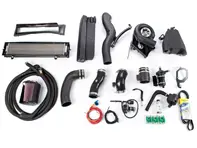

Upgrade to 470 hp / 360 ft/lbs
The VF-Engineering designers set about designing the billet supercharger mounting bracket with CAD software creating solid models of parts to be CNC manufactured. The bracket was designed to utilize OEM bolt patterns and requires no alteration or relocation of any engine parts to be fitted. Made from 6061-Tx aircraft grade aluminum the bracket mounts to factory machined surface points on the aluminum engine block for a precision fit.
A V3 model Vortech Engineering supercharger unit was chosen after consultation with Vortech engineers and matching the engine's volumetric efficiency with supercharger compressor maps. The V3 unit contains helical-cut gears for super quite performance - virtually silent with the engine compartment lid closed. The V3 supercharger has a 20psi and 1000cfm maximum capacity and is an over-engineered part for this Porsche application which is geared to produce a conservative 6psi in the engine's intake manifold.
The fastidious design of the supercharger bracket, positions the belt driven supercharger to maintain use of the OEM spring loaded belt tensioner. The serpentine belt routing was designed to maintain the correct rotation of all the accessories and maintain optimal pulley wrap for maximum friction.
The Vortech air to water intercooler (charge cooler) was integrated into the tight fit engine bay as means of reducing charged induction (boost) temperatures. Lower charge temperatures promote engine safety by reducing knock and improving the quality of the combustion cycle. Air charge (boost) from the supercharger is directed through the chargecooler core before entering the throttle body. The cooler core contains isolated channels circulating with water from a separate self contained system cooled by its own radiator. VF-Engineering integrated a Porsche OEM front radiator and front bumper vents into the kit. Water is circulated by means of an added OEM Bosch water pump through OEM Good Year water lines. Intake air temperatures in the manifold were measured to be approx 140 deg F even with 'spirited' driving at 118 deg F ambient temperatures in Arizona desert conditions mid-Summer. This dramatic drop in charge temperature helps the 996 create consistent power. For added safety the chargecooler is designed to perform continuously whilst the ignition is on.
With all major components in place the head of R&D at VF-Engineering, set about shaping the air ducts from the filter to the throttle body. The intake pipe is specially tuned for its air flow characteristics and pressure relief system. Production pipes are manufactured from a lightweight molded high temperature polymer. The thermal insulating properties of the plastic pipes prevent heat transfer into the cooled charged air traveling inside them.
Engine management software was by written by VF with extensive testing performed on independent test cars. Multiple factors such as charge air temperatures, ignition timing, fuel trims, maps and injector performance were taken into account. The Carrera 2 and 4 test vehicles were extensively dynoed on the VF 4WD Mustang and monitored for wide band air fuel ratios at load levels often greater than would be experienced on the road. The results are an increase of 120 horsepower and 80 ft.lbs of fully useable torque.
Fits:
Porsche 996 Carrera 2002>>
USA:
This product is not compliant with the California Air Resourse Board and not for use on public roads in California. This applies to any aftermarket product that does not display a CARB EO#.
- Porsche 996 C2 3.6L 09/01-2005
- Porsche 996 C4 3.6L 09/01-2005
- Porsche 996 C4S 3.6L 09/01-2005
 Shop Securely
 12 Month Warranty
 Worldwide Delivery
 Free delivery
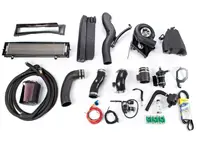
Upgrade to 425 hp / 360 ft/lbs
Fits:
Porsche 996 Carrera 1999-2001
The VF-Engineering designers set about designing the billet supercharger mounting bracket with CAD software creating solid models of parts to be CNC manufactured. The bracket was designed to utilize OEM bolt patterns and requires no alteration or relocation of any engine parts to be fitted. Made from 6061-Tx aircraft grade aluminum the bracket mounts to factory machined surface points on the aluminum engine block for a precision fit.
A V3 model Vortech Engineering supercharger unit was chosen after consultation with Vortech engineers and matching the engine's volumetric efficiency with supercharger compressor maps. The V3 unit contains helical-cut gears for super quite performance - virtually silent with the engine compartment lid closed. The V3 supercharger has a 20psi and 1000cfm maximum capacity and is an over-engineered part for this Porsche application which is geared to produce a conservative 6psi in the engine's intake manifold.
The fastidious design of the supercharger bracket, positions the belt driven supercharger to maintain use of the OEM spring loaded belt tensioner. The serpentine belt routing was designed to maintain the correct rotation of all the accessories and maintain optimal pulley wrap for maximum friction.
The Vortech air to water intercooler (charge cooler) was integrated into the tight fit engine bay as means of reducing charged induction (boost) temperatures. Lower charge temperatures promote engine safety by reducing knock and improving the quality of the combustion cycle. Air charge (boost) from the supercharger is directed through the chargecooler core before entering the throttle body. The cooler core contains isolated channels circulating with water from a separate self contained system cooled by its own radiator. VF-Engineering integrated a Porsche OEM front radiator and front bumper vents into the kit. Water is circulated by means of an added OEM Bosch water pump through OEM Good Year water lines. Intake air temperatures in the manifold were measured to be approx 140 deg F even with 'spirited' driving at 118 deg F ambient temperatures in Arizona desert conditions mid-Summer. This dramatic drop in charge temperature helps the 996 create consistent power. For added safety the chargecooler is designed to perform continuously whilst the ignition is on.
With all major components in place the head of R&D at VF-Engineering, set about shaping the air ducts from the filter to the throttle body. The intake pipe is specially tuned for its air flow characteristics and pressure relief system. Production pipes are manufactured from a lightweight molded high temperature polymer. The thermal insulating properties of the plastic pipes prevent heat transfer into the cooled charged air traveling inside them.
Engine management software was by written by VF with extensive testing performed on independent test cars. Multiple factors such as charge air temperatures, ignition timing, fuel trims, maps and injector performance were taken into account. The Carrera 2 and 4 test vehicles were extensively dynoed on the VF 4WD Mustang and monitored for wide band air fuel ratios at load levels often greater than would be experienced on the road. The results are an increase of 120 horsepower and 80 ft.lbs of fully useable torque.
VFD-006 911 Track Sport Upgrade (1998-2008) CLICK HERE
VFD-005-2 911 Street Sport (1998-2008) CLICK HERE
Supercharger Service Notes CLICK HERE
USA:
This product is not compliant with the California Air Resourse Board and not for use on public roads in California. This applies to any aftermarket product that does not display a CARB EO#.
- Porsche 996 C2 3.4L 1997-08/01
- Porsche 996 C4 3.4L 1997-08/01
- Porsche 996 C2 3.6L 09/01-2005
- Porsche 996 C4 3.6L 09/01-2005
Shop Securely
12 Month Warranty
Worldwide Delivery
Free delivery

Upgrade to 510 hp / 380 ft/lbs
The VF-Engineering designers set about designing the billet supercharger mounting bracket with CAD software creating solid models of parts to be CNC manufactured. The bracket was designed to utilize OEM bolt patterns and requires no alteration or relocation of any engine parts to be fitted. Made from 6061-Tx aircraft grade aluminum the bracket mounts to factory machined surface points on the aluminum engine block for a precision fit.
A V3 model Vortech Engineering supercharger unit was chosen after consultation with Vortech engineers and matching the engine's volumetric efficiency with supercharger compressor maps. The V3 unit contains helical-cut gears for super quite performance - virtually silent with the engine compartment lid closed. The V3 supercharger has a 20psi and 1000cfm maximum capacity and is an over-engineered part for this Porsche application which is geared to produce a conservative 6psi in the engine's intake manifold.
The fastidious design of the supercharger bracket, positions the belt driven supercharger to maintain use of the OEM spring loaded belt tensioner. The serpentine belt routing was designed to maintain the correct rotation of all the accessories and maintain optimal pulley wrap for maximum friction.
The Vortech air to water intercooler (charge cooler) was integrated into the tight fit engine bay as means of reducing charged induction (boost) temperatures. Lower charge temperatures promote engine safety by reducing knock and improving the quality of the combustion cycle. Air charge (boost) from the supercharger is directed through the chargecooler core before entering the throttle body. The cooler core contains isolated channels circulating with water from a separate self contained system cooled by its own radiator. VF-Engineering integrated a Porsche OEM front radiator and front bumper vents into the kit. Water is circulated by means of an added OEM Bosch water pump through OEM Good Year water lines. Intake air temperatures in the manifold were measured to be approx 140 deg F even with 'spirited' driving at 118 deg F ambient temperatures in Arizona desert conditions mid-Summer. This dramatic drop in charge temperature helps the 997 create consistent power. For added safety the chargecooler is designed to perform continuously whilst the ignition is on.
With all major components in place, the head of R&D at VF-Engineering set about shaping the air ducts from the filter to the throttle body. The intake pipe is specially tuned for its air flow characteristics and pressure relief system. Production pipes are manufactured from a lightweight molded high temperature polymer. The thermal insulating properties of the plastic pipes prevent heat transfer into the cooled charged air traveling inside them.
Engine management software was by written by VF with extensive testing performed on independent test cars. Multiple factors such as charge air temperatures, ignition timing, fuel trims, maps and injector performance were taken into account. The Carrera 2 and 4 test vehicles were extensively dynoed on the VF 4WD Mustang and monitored for wide band air fuel ratios at load levels often greater than would be experienced on the road. The results are an increase of 120 horsepower and 80 ft.lbs of fully useable torque.
Fits:
Porsche 997 S 3.8L
USA:
This product is not compliant with the California Air Resourse Board and not for use on public roads in California. This applies to any aftermarket product that does not display a CARB EO#.
- Porsche 997 MK1 Carrera 2S 3.8L 2005-08
- Porsche 997 MK1 Carrera 4S 3.8L 2005-08
Shop Securely
12 Month Warranty
Worldwide Delivery
Free delivery
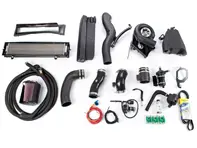
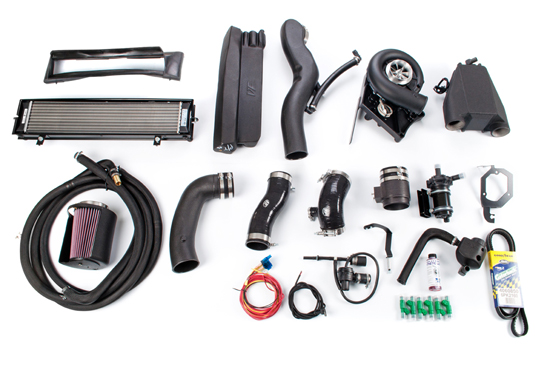

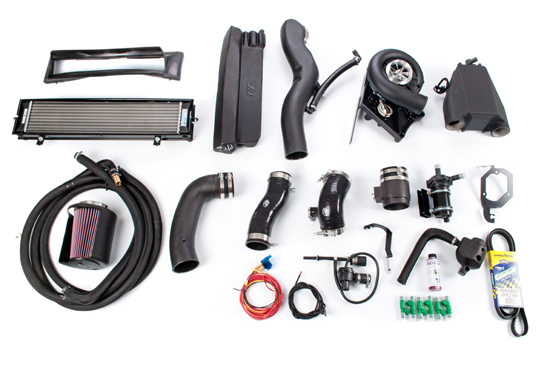
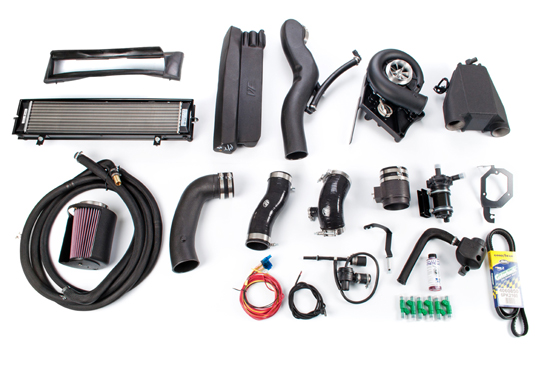
Upgrade to 480 hp / 370 ft/lbs
The VF-Engineering designers set about designing the billet supercharger mounting bracket with CAD software creating solid models of parts to be CNC manufactured. The bracket was designed to utilize OEM bolt patterns and requires no alteration or relocation of any engine parts to be fitted. Made from 6061-Tx aircraft grade aluminum the bracket mounts to factory machined surface points on the aluminum engine block for a precision fit.
A V3 model Vortech Engineering supercharger unit was chosen after consultation with Vortech engineers and matching the engine's volumetric efficiency with supercharger compressor maps. The V3 unit contains helical-cut gears for super quite performance - virtually silent with the engine compartment lid closed. The V3 supercharger has a 20psi and 1000cfm maximum capacity and is an over-engineered part for this Porsche application which is geared to produce a conservative 6psi in the engine's intake manifold.
The fastidious design of the supercharger bracket, positions the belt driven supercharger to maintain use of the OEM spring loaded belt tensioner. The serpentine belt routing was designed to maintain the correct rotation of all the accessories and maintain optimal pulley wrap for maximum friction.
The Vortech air to water intercooler (charge cooler) was integrated into the tight fit engine bay as means of reducing charged induction (boost) temperatures. Lower charge temperatures promote engine safety by reducing knock and improving the quality of the combustion cycle. Air charge (boost) from the supercharger is directed through the chargecooler core before entering the throttle body. The cooler core contains isolated channels circulating with water from a separate self contained system cooled by its own radiator. VF-Engineering integrated a Porsche OEM front radiator and front bumper vents into the kit. Water is circulated by means of an added OEM Bosch water pump through OEM Good Year water lines. Intake air temperatures in the manifold were measured to be approx 140 deg F even with 'spirited' driving at 118 deg F ambient temperatures in Arizona desert conditions mid-Summer. This dramatic drop in charge temperature helps the 997 create consistent power. For added safety the chargecooler is designed to perform continuously whilst the ignition is on.
With all major components in place, the head of R&D at VF-Engineering set about shaping the air ducts from the filter to the throttle body. The intake pipe is specially tuned for its air flow characteristics and pressure relief system. Production pipes are manufactured from a lightweight molded high temperature polymer. The thermal insulating properties of the plastic pipes prevent heat transfer into the cooled charged air traveling inside them.
Engine management software was by written by VF with extensive testing performed on independent test cars. Multiple factors such as charge air temperatures, ignition timing, fuel trims, maps and injector performance were taken into account. The Carrera 2 and 4 test vehicles were extensively dynoed on the VF 4WD Mustang and monitored for wide band air fuel ratios at load levels often greater than would be experienced on the road. The results are an increase of 120 horsepower and 80 ft.lbs of fully useable torque.
Fits:
Porsche 997 3.6L
USA:
This product is not compliant with the California Air Resourse Board and not for use on public roads in California. This applies to any aftermarket product that does not display a CARB EO#.
- Porsche 997 MK1 Carrera 2 3.6L 2005-08
- Porsche 997 MK1 Carrera 4 3.6L 2005-08
Shop Securely
12 Month Warranty
Worldwide Delivery
Free delivery

Monday-Friday: 8.30am - 5.30pm (GMT)
Saturday: Closed
Sunday: Closed